

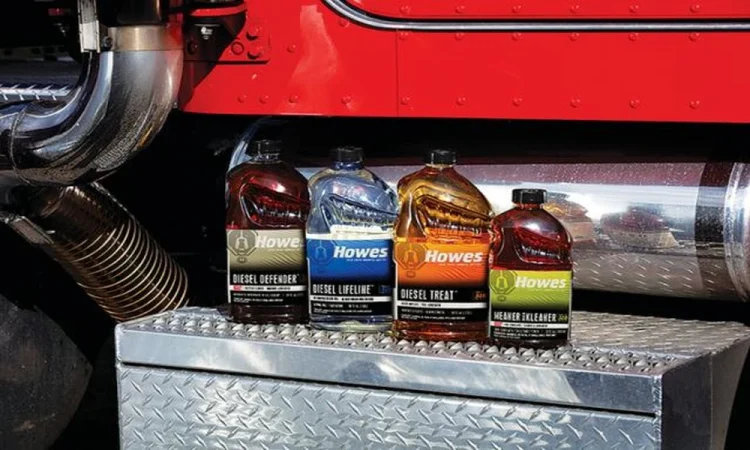

Most people who buy anti gel know they need it. The harder question is how much to pour in, and that is where mistakes happen. Too little leaves your fuel open to gelling. Guessing leaves you with a half-used bottle and a doubt every time the temperature drops.
I wrote this guide to give you clear numbers you can use at the pump. I based the advice on published treat rates, how diesel behaves in cold weather, and how different engines and tank sizes change the math. A good diesel anti gel additive comes with a treat rate on the label, and I will show you how to turn that rate into an amount for your own tank.
By the end, you will know the right dose for your temperature, your vehicle, and your tank size.
The Short Answer
Most anti gel products list their dose per gallon or per set number of gallons. For Howes Diesel Treat, the standard rate for the smaller bottles looks like this:
- Above 0°F: 1 ounce for every 5 gallons of fuel
- Below 0°F: 1 ounce for every 2.5 gallons of fuel
In per gallon terms, that is about 0.2 ounces per gallon above 0°F and 0.4 ounces per gallon below 0°F.
Cars, pickups, and tractors call for a double dose. Their fuel systems have smaller filters, and those filters clog faster when wax forms in cold fuel.
Why the Dose Changes With the Temperature
Diesel contains wax. When the fuel gets cold enough, that wax forms crystals. The crystals build up in your filter and block the flow of fuel. The temperature where this starts is called the cloud point. Gelling follows if the fuel keeps getting colder.
An anti gel works best when you add it before the fuel reaches the cloud point. Colder weather means a higher risk, and a higher risk means a larger dose. That is why the rate doubles when the temperature falls below 0°F.
Dose Examples You Can Use
Here are a few common tank sizes. These numbers use the standard rate, so remember to double them for a car, pickup, or tractor.
A 50 gallon tank
- Above 0°F: 10 ounces
- Below 0°F: 20 ounces
A 100 gallon tank
- Above 0°F: 20 ounces
- Below 0°F: 40 ounces
A 150 gallon tank
- Above 0°F: 30 ounces
- Below 0°F: 60 ounces
Bottle sizes make this easier. A 15 ounce bottle treats 75 gallons above 0°F. A quart treats 160 gallons, and a half-gallon bottle treats 320 gallons at the same temperature.
A Pickup Example
Say you drive a diesel pickup with a 30 gallon tank. The double dose rate applies to you.
- Above 0°F: 12 ounces
- Below 0°F: 24 ounces
Write these numbers on the bottle with a marker. You will not need to do the math again at every fill-up.
How to Add It the Right Way
The order matters. Follow these steps each time:
1. Check the forecast and pick the right rate for the lowest temperature you expect.
2. Pour the additive into the tank before you fuel up.
3. Fill the tank so the fuel mixes the additive as it flows in.
4. Repeat at every fill-up during cold weather.
Adding the product first gives you a better mix than pouring it on top of a full tank. Treat each tank of fuel as it goes in. Fuel you bought last month does not carry the protection from today’s bottle.
Can You Use Too Much?
Many drivers worry about this, and the answer is good news. Howes states that overtreating with their diesel products is not harmful. If you are unsure whether the weather will turn colder than expected, add a little extra. Gelling in the middle of a cold morning costs you far more than a few extra ounces of additive.
What If Your Fuel Already Gelled?
An anti gel prevents gelling. It cannot reverse it once the fuel passes its cloud point. If your fuel has already turned thick, you need a rescue product.
Howes makes Diesel Lifeline for this purpose. It changes the melting points of wax and ice crystals so thick fuel can flow again. It needs no pre-mixing with other diesel, and it is made with no alcohol or harmful solvents. I recommend a bottle in the cab or toolbox, especially if you drive a pickup or run a tractor. Smaller filters in those machines clog sooner, even with treated fuel.
Why I Point People to Howes
Several things set Howes apart for me when I compare products.
- A long history. The family-owned company in North Kingstown, Rhode Island, has made additives since 1920.
- A clear treat rate. Their dosing is simple to follow and easy to scale to any tank.
- Water handling. The formula pushes water out of the fuel so your water separator can remove it. They note that major engine makers prefer this method.
- Broad compatibility. Diesel Treat works in all diesel and biodiesel blends, including home heating oil. They describe it as warranty safe and particulate filter friendly.
- A winter guarantee. Their Winter Tow Guarantee promises to pay for the tow if a truck treated with the product fails to keep going.
Diesel Treat also adds lubricity, helps prevent injector deposits, and reduces cold filter plugging. You get more than gel protection from each dose.
Treating Bulk Fuel
If you store fuel in a drum, tank, or tote, look at Diesel Treat Concentrate. The rate is as strong as 1 gallon per 3,000 gallons above 0°F. It uses a wax crystal modifier that changes the size and shape of wax crystals so they cannot bind together. Farms and fleets with storage tanks can treat a large volume with a small amount.
Your Winter Routine
Keep it simple. Learn your tank size, pick the rate that matches your lowest expected temperature, and double it if you drive a car, pickup, or tractor. Add the product before you fuel, and keep a rescue bottle within reach.
Follow those steps, and your fuel will stay ready to flow when the cold arrives.