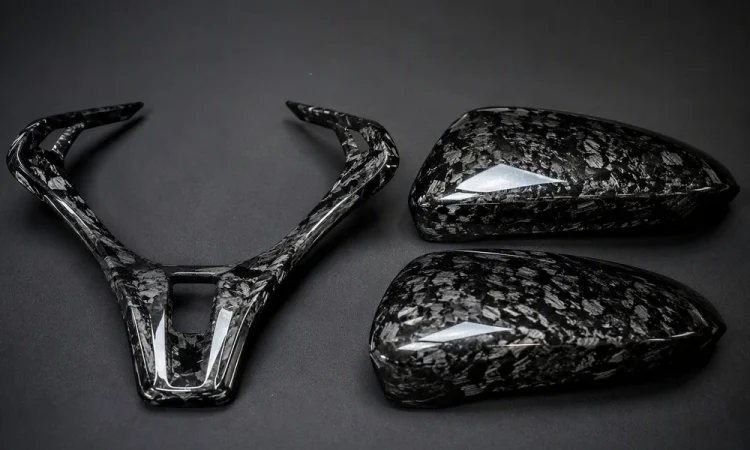
Where cloth fears to drape, compound flows.
Ask a composite engineer what keeps them up at night and you will not hear about strength or weight. You will hear about geometry. Woven carbon fabric is miraculous in two dimensions and stubborn in three. Every compound curve is a negotiation, every deep draw a small war. Forged carbon exists because of that war. This is the engineering case for chopped fiber: not the marble look, not the marketing, but the shapes it makes possible.
The Draping Problem
Woven fabric behaves like cloth because it is cloth. Lay it over a sphere and it wrinkles. Push it into a sharp corner and it bridges, leaving resin-rich voids beneath. Force it into complex three-dimensional geometry and you get either distorted weave, cut darts and overlaps, or a laminator’s slow defeat. Every one of those compromises costs strength, weight, or appearance, usually all three. Entire design departments exist to shape parts around what fabric will tolerate, and the carbon fiber fabrication process shows how much skill that tolerance demands.
How Chopped Fiber Answers
Forged carbon sidesteps the problem by changing the state of the material. Chopped fibers, 10 to 50 millimeters, mixed into resin form a compound that flows under pressure like a stiff paste. Compression molding squeezes it into every corner, rib, and curve of a matched mold. No draping, no bridging, no wrinkles, no darts. The geometry the designer drew is the geometry the part has. For shapes of real complexity, deep housings, organic curves, integrated ribs and bosses, this is not an improvement on weaving. It is a different universe.
The Multi-Directional Bonus
Complex shapes usually mean complex loads. Forces arriving from directions nobody fully predicts. Woven carbon handles known loads brilliantly and unknown loads nervously, since strength lives along the fibers. Forged carbon’s random fiber orientation gives moderate strength in every direction at once, which is exactly what an unpredictable load case wants. The forged vs woven carbon comparison quantifies the trade: lower peak, higher floor, no weak axis. For brackets, fittings, and structural nodes, that profile is often the right answer outright.
Speed as an Engineering Feature
Cycle time sounds like a business metric, but it changes what engineers may design. Hand layup runs in hours, so woven carbon parts are kept simple to keep them economical. Compression molding runs in minutes, which means complexity is suddenly affordable. Integrated mounting points, ribs, channels, and features that would have required bonded secondary pieces in woven construction can be molded in one shot. Fewer bonds mean fewer failure modes. The part gets more complex and more reliable at once, a trade engineering rarely gets to make.
The Tooling Economics Behind the Shapes
None of this is free, and the honest cost story is worth knowing. Compression molding requires matched metal tooling. Precision steel molds that cost real money up front. The economics only work when the tooling amortizes across a production run, which is why forged carbon first appeared on low-volume supercars and why aftermarket forged parts cluster on popular platforms: the mold must be fed. This is the invisible constraint shaping the catalog. Where you see forged parts offered, a manufacturer judged the volume worth the steel. Where you do not, the math has not arrived yet. But it arrives further every year.
The Recycling Bonus
One last engineering elegance: forged carbon is the natural home of recycled fiber. Chopped fiber reclaimed from manufacturing scrap and retired parts cannot be re-woven into fabric. But it flows into compression molds beautifully. As recycled carbon supply grows, the forged process stands ready to absorb it, turning the industry’s waste stream into feedstock for its fastest-growing process. The material that solved the geometry problem may also quietly solve the landfill problem.
Where the Case Is Strongest
- Structural brackets and nodes: complex loads, complex shapes, forged’s home turf.
- Engine covers and intake components: heat-managed zones with organic geometry.
- Suspension and subframe elements in low-volume performance cars: proven in production.
- Complex aero fittings: where woven would need darts and forged flows in clean.
- Anywhere a part needs features, not just surfaces.
Where Woven Still Wins
The honest boundary: large, gently curved, load-directional panels. Hoods, roofs, wings, where the loads are known and the geometry is kind, remain woven territory, because continuous fiber’s directional strength and classic appearance both matter there. Forged carbon did not come to replace weaving. It came to absorb every shape weaving could not serve. The carbon fiber material guide covers the properties both constructions share.
Engineering history is full of materials that won by being better. Forged carbon won by being possible. The shapes, speeds, and load cases that cloth could never reach. The marble pattern everyone notices is just the signature of a material that flows. What matters is where it flows to: everywhere the weave could not go.